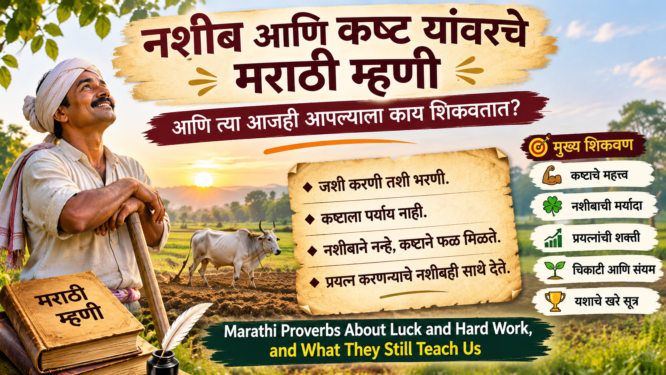
Every language carries the wisdom of the people who speak it, and Marathi is especially rich in proverbs. Known as म्हणी, these short sayings have been passed down through generations, repeated by grandparents, quoted by teachers and used in everyday conversation to make a point quickly. Many of them deal with a question people have always asked: how much of life depends on luck, and how much on our own effort?
Here are some of the best-known Marathi proverbs on luck and hard work, with their meanings and a few thoughts on why they still feel relevant today.
Luck, chance and games in daily life
Ideas about fortune run deep in Indian culture. Families play cards during Diwali, children argue over dice in ludo, and almost everyone has a story about a lucky break or a near miss. Marathi proverbs often take a firm view on this: luck may play a part, but it is no substitute for work.
That old wisdom is useful in the digital age too. Social media is full of ads promising quick wins, and many people look for real-money gaming sites without realising the law has changed. As the Press Information Bureau explains, the Promotion and Regulation of Online Gaming Act, 2025 imposes a complete ban on online money games, whether they rely on chance, skill or both, and prohibits their advertising. Readers who see online casinos in India mentioned online should keep that in mind and stay well informed. As the proverbs below remind us, steady effort has always been a more reliable path than hoping for a lucky streak.
प्रयत्नांती परमेश्वर
Perhaps the most famous Marathi saying on the subject, “प्रयत्नांती परमेश्वर” roughly means “God is found at the end of effort”. In other words, success comes to those who keep trying. Parents often use it to encourage children before exams, and it is a favourite line in school speeches and motivational posters. The message is simple: do your part fully, and results will follow.
थेंबे थेंबे तळे साचे
“थेंबे थेंबे तळे साचे” translates as “drop by drop, a lake fills up”. It is the Marathi version of the idea that small, consistent actions lead to big results. It applies to saving money, building a skill, studying for exams or growing a business. Nobody fills a lake in a day, but nobody fills it without starting either.
दैव देते आणि कर्म नेते
This proverb, “दैव देते आणि कर्म नेते”, means “fate gives, and one’s actions take away”. It recognises that people sometimes receive good fortune, but warns that careless behaviour can quickly waste it. It is often used when someone gets a great opportunity and then lets it slip through poor choices. Luck, in this view, is only the beginning; what you do with it decides the outcome.
असेल माझा हरी तर देईल खाटल्यावरी
With a gentle touch of humour, “असेल माझा हरी तर देईल खाटल्यावरी” describes a person who says, “If God wishes, he will give it to me right here on my cot.” It pokes fun at those who sit back and wait for luck to deliver everything. The saying is usually used to tease someone who avoids effort while hoping for good results.
कष्टाचे फळ गोड असते
“कष्टाचे फळ गोड असते” means “the fruit of hard work is sweet”. It reminds us that rewards earned through effort feel far more satisfying than anything gained by chance. Farmers, students, athletes and entrepreneurs all know this feeling well.
Why these sayings still matter
Marathi literature and oral tradition carry centuries of wisdom, and the language’s heritage has received national recognition: in October 2024, the Union Cabinet conferred Classical Language status on Marathi along with Pali, Prakrit, Assamese and Bengali. Proverbs are one of the most everyday ways that heritage lives on.
They also work beautifully as quotes. You can use them as WhatsApp statuses, captions for achievement photos, messages for students before exams or reminders for yourself on a tough day. Short, memorable and full of meaning, they continue to guide people through modern challenges just as they guided earlier generations.
Sharing proverbs with the next generation
One of the best ways to keep these sayings alive is to use them naturally at home. Explaining a proverb to a child when the moment fits, such as saving coins in a piggy bank with “थेंबे थेंबे तळे साचे”, helps the words stick far better than any textbook. In that way, a few simple lines can carry a whole culture’s values forward.